
Lidl Aims to Lead in Sustainability and Health
Lidl has set its sights on becoming a frontrunner in the areas of sustainability and health. The supermarket chain is taking a dual approach: on one hand, it aims to protect the environment—for instance, by tackling food waste and promoting biodiversity—while on the other, it wants to help consumers make more informed choices. This includes encouraging healthier eating habits with less sugar, less salt, more whole grain and fewer animal-based proteins. “These two goals often go hand in hand,” says Chantal Goenee, Sustainability and Health Advisor at Lidl.
Lidl is aligning its product range with the Planetary Health Diet (PHD)—a scientifically grounded dietary model that promotes both human and planetary health. A predominantly plant-based diet is considered key to feeding the projected global population of 10 billion by 2050 in a sustainable and healthy way. Lidl has set several concrete targets: by 2030, 60% of its protein sources must be plant-based. The retailer is also expanding its selection of organic fruits and vegetables, increasing its offering of wholegrain products, continuing reductions in sugar and salt, and promoting less processed foods.
Logical step
For Goenee, Lidl’s commitment is a logical step. “Why wouldn’t we do this? Everyone benefits from this strategy. We sometimes joke that if people grow old in good health, they can be our customers for longer. But our motivation goes beyond business—it comes from an intrinsic drive and the awareness that supermarkets influence consumer behaviour. After all, 70% of food is purchased in supermarkets. That gives us the opportunity to make a real impact.”
The responsibility for promoting the Planetary Health Diet doesn’t rest with Lidl alone. Governments, producers, and consumers also have roles to play. “We can’t do this by ourselves,” Goenee emphasizes. But Lidl takes responsibility, while remaining careful not to force choices upon consumers. “We aim to ensure that shopping baskets gradually become more filled with healthier products. One way to achieve this is by offering plant-based alternatives at the same price as their animal-based counterparts, so that price isn’t the deciding factor for consumers.”
Plant-based as a default
Lidl also promotes healthier and more sustainable products through its marketing. “For our meal kits, we now feature a plant-based recipe on the packaging. In the past, meat was the default, and we would add a tip for how to make it vegetarian or vegan. Now, we’ve reversed that.”
Last year, Lidl ran a trial by placing meat substitutes alongside regular meat products. While the sales of meat alternatives increased—which the company welcomed—the sales of meat itself did not decline, leading to the pilot’s end. “It can be challenging to balance strategy with consumer preferences,” Goenee admits. “It’s not always easy to deal with resistance, which is why we don’t force customers to eat plant-based. We believe in a balanced diet, in which meat and dairy still play a role, according to the national dietary guidelines. But perhaps meat and dairy should be considered more special again, instead of being the default.”
Gradually improved
Many consumers say they want to eat healthily, and often prioritize this over sustainability. However, resisting foods high in sugar, fat, and salt remains difficult. “That’s true,” says Goenee, “which is why we improve our products gradually. Rather than making a major salt reduction all at once, we do it in smaller steps so customers can get used to the taste.” Lidl is also responding to growing demand for less processed foods and products with fewer additives. “Because we primarily sell private-label products, we can make changes more easily—our communication with producers is direct and efficient.” Importantly, Lidl does not intend to ban less healthy foods but hopes to strike a better balance between nutritious choices and indulgent moments.
Lidl is the largest supermarket chain in Europe, operating in 31 countries. While the PHD strategy is shared across all markets, each country adapts it to local needs. “In the Netherlands, for example, anticipating on upcoming legislation, we stopped selling tobacco several years ago as the first supermarket.” Furthermore, every country is taking it’s own measures. An example that I am proud of is that, in the light of our target to increase the sales of whole grain, we have made the decision that in our wholegrain meal salads the grain component is always whole grain. In the end we also believe whole grain products need to become the norm.”
Impact on a daily basis
For Goenee, working at Lidl is a dream job. “I studied Health Sciences and have been with Lidl for five and a half years. Before that, I worked at Unilever—another company taking steps in sustainability and health. I’d always wanted to work for a supermarket, so I sent an open application to Lidl—the store where I also did my own shopping. I was hired, and now I get to work every day on improving public health and building a sustainable future. I am very happy with my job, even if there are challenges. Sometimes the steps we take are smaller than I’d like, but the most important thing is that we’re making progress.”
Goenee will share more about her work and Lidl’s strategy during her presentation at the IFFI event ‘Salt, Less is More’ on May 15.
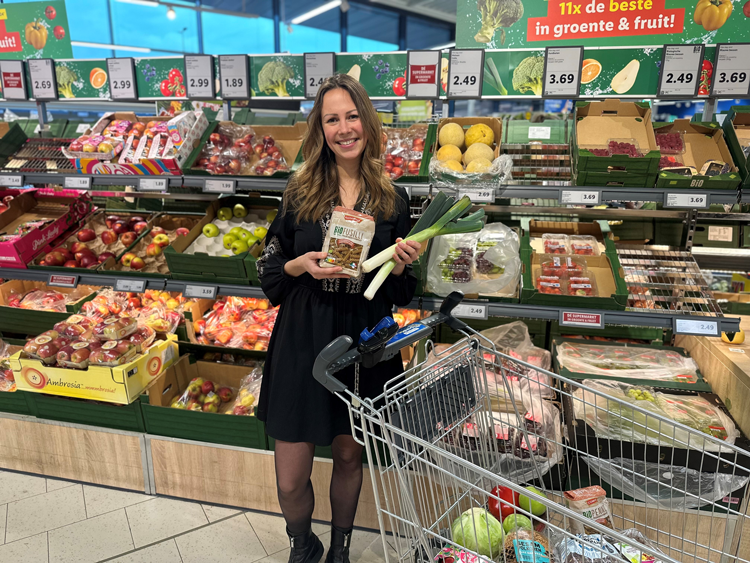

Chantal Goenee
Sustainability and Health Advisor at Lidl