
From scarcity to scale: how Revyve turned yeast into a food industry breakthrough
While many food start-ups struggle to scale, Revyve has successfully made the leap. The company now employs 35 people. According to co-founder Corjan van den Berg, this success is no coincidence.
An almost unlimited raw material source
One of the key conditions for the company’s success is the availability of raw materials. According to Van den Berg, Revyve works with an almost inexhaustible source of baker’s and brewer’s yeast. “If we ever see the end of that supply coming into sight, that’s when we’ll know we’ve truly become a successful start-up,” Van den Berg jokes. From this yeast, functional proteins and fibers are extracted, which can replace eggs in products such as sauces, meat alternatives, and bakery goods. The technology involves breaking open the cells and using mild, low-temperature processing to obtain proteins and fibers. This results in ingredients with unique functional properties, including foaming, gelation, and emulsification. “It provides a real alternative to eggs,” Van den Berg explains. “Moreover, you need much less of our powder to achieve the same or even better results. That makes it highly cost-effective, which is essential in the food industry where margins are small.”
Building a company out of frustration and determination
Van den Berg founded the company in 2019 together with his partner, Edgar Suarez. “Out of frustration that I couldn’t get funding for my research, I thought: I’ll just do it myself.” They had not a penny to spare, yet started the adventure with energy and drive. “If you want to succeed, you shouldn’t make things too fancy, but they can’t be too basic either. It needs to be a bit exciting, but not so exciting that food producers see it as risky. Keeping costs under control is also crucial.” According to Van den Berg, this is where many start-ups go wrong. “You can develop a fantastic technology in the lab, but if it becomes too expensive to scale up, you have a problem. That’s why we wanted to keep it as simple as possible for as long as possible. Complexity comes naturally once you start scaling.”
Embracing scarcity as a strategy
The founders deliberately avoided the trap of purchasing expensive equipment in the early stages. “Normally, companies donate equipment to universities once it has served its purpose. In our case, we refurbished a machine the university had written off so that it could function as a texture analyser. It still works.” Van den Berg refers to this as embracing scarcity, a method that has helped the company repeatedly. As Revyve scaled up, new equipment was eventually purchased. “The organisation is becoming more professional, but I try to maintain the spirit of the early years.”
Returning to what he loves most: r&d
For Van den Berg personally, growth has meant a shift in role. “In the past, one day I was a researcher, the next day I handled HR, and the day after that I was doing sales. We now have people who are much better at those roles.” Today, he focuses on what he enjoys most: research and development. “I’m exploring whether we can develop new ingredients from biomass, precision fermentation, and microalgae. We’re also investigating the potential of fibers.”
The constant chicken and egg challenge
The biggest challenge for the company is the time required for development. “It’s a constant chicken and egg situation. As a company, you want to scale up, but that’s only possible if there’s sufficient market interest. Once the interest is there, you can barely meet demand in the first few months, because scaling takes time. It remains difficult to determine exactly when to take the next step.”
Investing in communication
From the very beginning, Revyve invested in a strong communication strategy, something clearly reflected in its website. “Although there’s always room for improvement,” Van den Berg admits. “For a start-up, having a clear and compelling story is essential. Your message must be clear. You need to guide potential customers and explain what value your product offers. You must be very aware of your target audience and tailor your message accordingly. Keep scientists far away from that process!” he jokes.
The value of networks and collaboration
Revyve became familiar with IFFI through an event in 2023. “That’s where I met Arianne. When we received an invitation to become a member, I asked her what we should do. ‘Join,’ she said.” What he particularly appreciates is that not only he, but people at various levels within the company were invited to participate. “In this way, we are truly engaged in the network as an organisation. The most important aspect of membership is that we can learn from each other. That builds mutual trust, and from that, the most valuable collaborations can emerge.”
https://revyve.bio
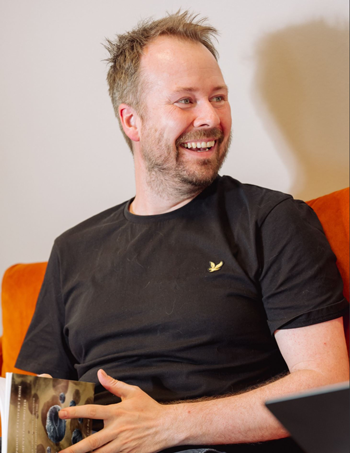
Corjan van den Berg
Co-founder Revyve