
Jose Guerrero: A Chef in a Scientist’s World
Jose Guerrero spent years working in Michelin-starred restaurants before making an unexpected career move. Today, as R&D Chef EMEA at Cargill, he develops food products that will ultimately be enjoyed by millions of people around the world. On 17 September, he will share his remarkable journey during the IFFI Culinology® event in a presentation titled Science and Food Interactions: A Chef in a Scientist’s World.
“My curiosity brought me here,” Guerrero says. “I want to understand everything about food, including the science behind it.” According to Guerrero, the culinary world and the scientific world are much further apart than most people realise. “Chefs and scientists literally speak different languages. They think differently, they work differently and they approach food from completely different perspectives. Crossing that divide isn’t easy. But once you do, that’s where real innovation begins.”
R&D Chef
Curiosity has shaped his career from the very beginning. Rather than attending a traditional culinary school, Guerrero chose to study Gastronomy at university, where culinary arts were combined with food science, hospitality, viticulture and restaurant management. After graduating, he set his sights on the highest level of fine dining. “I wanted to work in Michelin-starred restaurants. During my internship, people noticed how curious I was. In my spare time I read everything I could find about food and cooking, and the next day I would come back with new ideas for the menu. That eventually opened the door to the restaurant’s R&D department, where I grew into the role of R&D chef.”
Bigger impact
Although working in some of the world’s finest restaurants was a dream come true, Guerrero gradually realised he wanted to make a broader impact. “I loved creating exceptional dishes, but only a small number of people would ever have the opportunity to taste them. I wanted to reach more people. Everyone shops at supermarkets, regardless of their background or income. If you develop products there, you can make a real difference for millions of consumers.”
New language
That transition sparked a whole new set of questions. “Why does soup have such a long shelf life? Why does one sauce have a certain texture? As a chef, I couldn’t fully explain those things.” Determined to find the answers, Guerrero enrolled in a Master’s programme at the Basque Culinary Center. “That experience completely changed my perspective. I finally acquired the scientific tools to answer the questions that had always fascinated me. I worked on innovation projects with food companies and learned to speak the language of scientists.”
Innovation
For Guerrero, scientific knowledge forms the foundation of culinary creativity. “When you understand how flavour is built, you can innovate much more effectively. Take a strawberry, for example. Its flavour is made up of dozens of different chemical compounds. Or think about the beautiful brown crust on grilled meat. Once you understand the reactions between proteins and sugars that create it, you also understand how to control those processes.”
Sensory science
Yet science alone is not enough. “Sensory science was the biggest reason I moved into research. Food isn’t just about flavour. Texture, aroma, colour, sound and even the environment all influence how people experience what they eat.” He points to research demonstrating just how powerful those influences can be. “What happens if someone eats exactly the same dish in a bright white room instead of a warm, cosy restaurant? Does the weight of the cutlery matter? What music is playing? Studies have even shown that people are more likely to order expensive French wine when French music is playing in the background.”
Travel the world
After completing his studies, Guerrero founded his own innovation company, Anima—Latin for soul—in Hungary. Working from his own laboratory, he collaborated with restaurants and food companies while specialising in neuroscience, biotechnology and fermentation. His work also took him around the world in search of new knowledge. “Japan felt like travelling into the future. I learned an incredible amount about fermentation there.”
Tea plantations
China also left a lasting impression. “It took years to build relationships. I attended the same conference in Hong Kong several times. The first time, I didn’t speak the language. Before my second visit, I had started learning Mandarin. Eventually, I was invited into people’s homes and visited tea plantations. Those experiences led to projects such as developing premium kombucha. Building that kind of trust takes years, but the knowledge you gain is invaluable.”
Cargill
After five years, Guerrero returned to Spain, ready for a new challenge. That challenge eventually came in the form of Cargill. “To be honest, I had never fully realised how much of an impact Cargill has on the global food supply. Almost every meal contains an ingredient produced by Cargill somewhere along the supply chain. That really appealed to me. Everything we develop here has the potential to be enjoyed by millions of people. It gives you an opportunity to make a real impact on sustainability, health and, of course, taste.”
Taste, taste, taste
His years as a chef continue to shape the way he approaches product development. “In a laboratory, recipes are carefully standardised and controlled. But sometimes people simply don’t taste enough.” That, he believes, is one of the biggest differences between chefs and scientists. “As a chef, you’re constantly aware that someone will be eating your dish within minutes. You think about real-life situations. Scientists naturally focus more on the process itself.”
Tomato sauce
He illustrates this with a simple example. “When you’re developing a tomato sauce, a chef immediately imagines how consumers will actually use it. They’ll probably serve it with pasta or lasagne. Maybe they’ll leave it simmering too long because they’re distracted. If the sauce fails, consumers rarely blame themselves, they blame the product. That’s something you need to anticipate during development, perhaps by choosing a starch that performs better under those conditions.”
Flavour library
His culinary background is equally valuable when recreating existing flavours. “You can’t simply ask another manufacturer for their recipe. But chefs build an enormous flavour library in their minds. By tasting carefully, you can often identify the ingredients that are likely to be present and recreate the flavour from scratch.”
Think like a chef
Guerrero believes every food scientist can benefit from thinking a little more like a chef. “Curiosity is essential. Try unfamiliar dishes. Buy products you’ve never tasted before. There’s nothing wrong with eating the same cheese sandwich every day, but you won’t develop your palate that way.”
Social network
After all these years, one aspect of food continues to fascinate him more than anything else. “Food brings people together. It may well be the world’s biggest social network.” At the same time, he remains deeply fascinated by the science behind everyday foods. “When you realise that a bottle of Champagne may take more than two years before it reaches the shelf, or that traditional kimchi can ferment for six months before it’s ready, you gain a completely different appreciation for what you’re eating.”
Magic
For Guerrero, that combination of curiosity, scientific understanding and human connection continues to drive everything he does. “Creativity doesn’t simply appear. It’s not magic. It begins with knowledge. You have to travel, taste, read, talk to people and keep learning. Only then can you truly innovate.”
Jose is one of the speakers during the event on 17 September. More info and registration Culinology Event, 17 September.
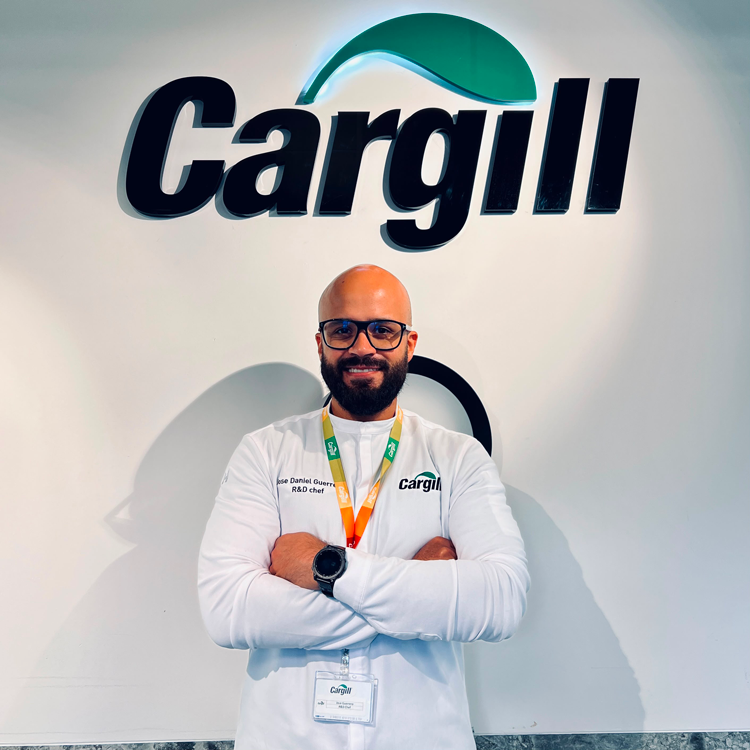
Jose Guerrero
R&D Chef EMEA at Cargill