
Anna Cheely: Bringing Science and Flavour Together
As Senior Culinary Innovation Manager at Kalsec and Vice President of the Research Chefs Association (RCA), Anna Cheely operates at the intersection of culinary creativity and food science. From Kalsec’s Taste & Sensory Innovation department, she develops culinary-inspired solutions for customers ranging from seasoning and sauce manufacturers to major consumer packaged goods companies. Her work spans the entire innovation process, from early concepts and prototypes to commercial launch. This year, as the RCA celebrates its 30th anniversary, Cheely reflects on the evolution of both the association and the profession it helped define.
For Cheely, one of the RCA’s greatest achievements is the culture of openness it has fostered over the past three decades. “RCA is a platform where people share knowledge,” she says. “That’s quite remarkable when you consider that many of us are, in one way or another, competitors. Yet there has always been a spirit of collaboration. The focus is on learning from one another because, ultimately, we all want to improve the food industry as a whole.”
Culinology®
The association has also played a pivotal role in the development of Culinology®, the discipline that bridges culinary arts and food science. A registered trademark of RCA, Culinology was coined by RCA founder Winston Riley as a way to describe a new profession that combined the creativity of the kitchen with the rigour of scientific research. “At the time, it was a new word for a new discipline,” Cheely explains. “Today, the meaning has expanded significantly. Some companies even use ‘Culinologist’ as an official job title. That shows how much value the industry now places on professionals who can work across both worlds.”
Team effort
Outside the industry, however, many people still struggle to understand what a research chef actually does. It is a question Cheely hears frequently. “My title sounds more complicated than it really is,” she laughs. “At its core, I’m a product developer with the knowledge and perspective of a chef. I combine scientific understanding of ingredients with expertise in flavour, preparation and culinary application.” That role requires constant collaboration across disciplines. Developing a successful food product is about far more than taste alone. Colour, texture, shelf life, pricing, consumer expectations and marketing considerations all need to be balanced. “You work closely with colleagues from many different departments. Product development is truly a team effort.”
Her career path reflects a lifelong curiosity about how things work. Long before she entered the food industry, she was the child who always wanted to know why. “I’ve always been fascinated by understanding why things are the way they are. That curiosity naturally drew me towards science.”
Sharing food and knowledge
At the same time, food played an important role in her upbringing. Raised by a single father who loved to cook, she discovered early on that cooking offered a unique combination of creativity and control. “In life, many things are unpredictable. Cooking was something I could influence myself. If I added too much sauce, that was my own doing. I found that fascinating.” Today, she describes herself as a true foodie. “I think about food all the time. I love inviting people over, sharing meals and bringing people together. Whether it’s food or knowledge, I enjoy sharing what I have with others.”
Define heat perception
One of the challenges currently attracting significant attention within the food industry illustrates perfectly why both culinary and scientific perspectives are needed. Around the world, companies are trying to better understand and define heat perception in food products. “Analytically, we can measure the amount of major capsiacinoids in a pepper,” Cheely explains. “Capsiacinoids binds to heat receptors in the mouth, creating the sensation of burning. But consumer perception doesn’t always align with what the scientific data tells us.”
According to Cheely, heat perception is influenced by far more than chemistry alone. Texture, temperature, aroma, colour and context all contribute to how consumers experience a product. “That’s what makes it so difficult to define heat objectively. Customers ask us about it all the time, but the answer is much more complex than people expect.”
Science versus perception
The same challenge applies to flavour development more broadly. Consumers often have a very specific expectation of what a flavour should taste like. “Take strawberries or parsley,” she says. “We know the compounds that contribute to those flavour profiles, and we can analyse them scientifically. But even if you recreate the exact combination of compounds, there’s no guarantee consumers will perceive it in the way you intended.” For Cheely, this gap between scientific precision and consumer perception remains one of the most fascinating aspects of food innovation.
While the industry has accumulated extensive knowledge about food safety, shelf life and large-scale manufacturing, flavour continues to be the defining factor in a product’s success. “Consumers increasingly expect convenience foods to taste as though they were freshly prepared. In the United States, we see people dining out less frequently and relying more on prepared foods. At the same time, they still expect restaurant-quality flavour experiences. Closing that gap represents one of the biggest opportunities for innovation in the years ahead.”
Broader foundation
It is also one of the reasons she remains optimistic about the future of Culinology. In the past, professionals often began their careers as either chefs or scientists and later returned to education to develop expertise in the complementary discipline. Today’s students are entering the workforce with a far broader foundation. “They are learning about both culinary arts and food science much earlier in their careers. That gives them a tremendous advantage. They also have a much stronger understanding of marketing and consumer behaviour than many of us did when we started.”
The growing number of RCA-accredited Culinology programmes is helping to strengthen the profession even further. At the same time, emerging technologies such as artificial intelligence could accelerate the pace of innovation. “There is an incredible amount of knowledge available today,” says Cheely. “AI may help us apply that knowledge more effectively and bring products to market faster. Or perhaps we’ll find ourselves overwhelmed by information.” She laughs before adding: “Either way, it’s going to be a very interesting time to be part of this industry.”
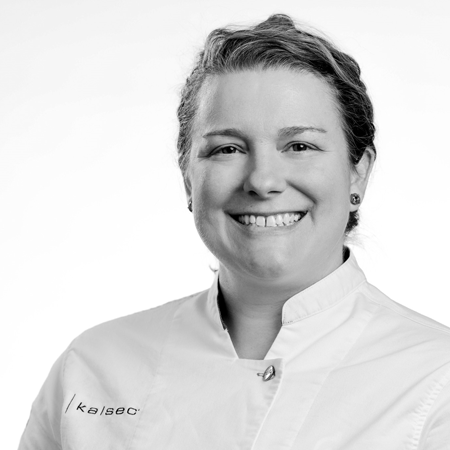
Anna Cheely
Senior Culinary Innovation Manager at Kalsec and Vice President of the RCA